June 25, 2018
It's 8:30 pm and we are at our mooring on the West River. The temperature in the salon is still 82F (28C) but in the V-berth the evening breeze provides a gentle freshness. Outside the temperature is balmy. Tomorrow we are leaving our mooring for new harbors and new acquaintances. It’s more than exciting. It has taken lots of work and tons of flexibility to get to this point.
After spending nearly a year refurbishing Rosalind in 2016, we wanted to head south that year. Some unexpected engine room work pushed back our departure until it got too cold to leave that season. Then, we tried going north the following summer but our plans were forced to change. In the fall, work intervened and changed our plans to go south that year too. Now we are going north, heading out almost two years later than originally planned.


Rosalind
It’s been a long road, but we have learned a lot along the way. We have learned how to live on board and have made a number of important improvements to Rosalind. But we have also learned to really enjoy the process, because at the end of the day, that really is cruising.
June 26, 2018
The weather window that we were waiting for had arrived. Mid-morning on Tuesday, June 26th, we picked up our mooring pennant and headed north on the Chesapeake Bay. The light following winds and seas with assistance from Lucy, our trusted Beta 30 horsepower engine, pushed us up the Bay. We passed Thomas Point Light and before long we were passing Annapolis, the furthest north we had ever sailed until now.

Chesapeake Bay Bridge
On the VHF radio there was a report of a school of dolphins spotted in the Chesapeake and we took that as a great omen for our cruise. Soon after, we passed under the Bay Bridge and turned east. The wind picked up from zero to 10 knots (0 to 19 km/h) in a matter of minutes, then it went up to 15 knots (28 km/h). We took advantage of the afternoon bay breeze and we had a beautiful sail to the Magothy River entrance. When we reached our destination and anchored in the Magothy River, the wind quickly rose to over 20 knots (37 km/h).
Over the years we had heard great stories about the Magothy and we were soon to discover what a special place the Magothy really is. We anchored in Forked Creek in 14 ft (4 m) of water and enjoyed a great dinner with a spectacular sunset while Rosalind rode out the strong breeze at anchor with her anchor riding sail.

Sunset, Magothy River, Chesapeake Bay
It's been a day of firsts for us:
- First time under the Chesapeake Bay Bridge
- First time in the Magothy River
- First time this far north
June 27, 2018
A weather front with strong thunderstorms was moving through the area so we decided to stay an extra day in the Magothy River. We stayed on board and worked on the port hardtop handle in the morning then, after lunch, we listened to podcasts and relaxed.

Motorsailing past Baltimore Light towards Worton Creek
June 29, 2018
We had to plan the next leg of the trip carefully because of the strong currents at the top of the Bay and particularly through the Chesapeake & Delaware (C&D) Canal. After consulting Eldridge, the nautical publication that has been providing tides and current information since 1875, we decided that we needed to get out of Worton Creek at first light if we wanted to make it to Chesapeake City without having to fight the current.
We got up before sunrise and at 5:35 am raised anchor and headed north towards the C&D Canal. The C&D Canal links the two namesake bays and offers a shortcut for both commercial and pleasure boats. The Canal is very well marked and is also lit for night transits. Our destination was Chesapeake City, 3 miles (5 km) into the Canal where there is a small anchorage. Chesapeake City is an interesting destination on its own and we planned to stage there in order to get a fair current to transit the remaining 12 miles (22 km) of the Canal.
We had to plan the next leg of the trip carefully because of the strong currents at the top of the Bay and particularly through the Chesapeake & Delaware (C&D) Canal. After consulting Eldridge, the nautical publication that has been providing tides and current information since 1875, we decided that we needed to get out of Worton Creek at first light if we wanted to make it to Chesapeake City without having to fight the current.
We got up before sunrise and at 5:35 am raised anchor and headed north towards the C&D Canal. The C&D Canal links the two namesake bays and offers a shortcut for both commercial and pleasure boats. The Canal is very well marked and is also lit for night transits. Our destination was Chesapeake City, 3 miles (5 km) into the Canal where there is a small anchorage. Chesapeake City is an interesting destination on its own and we planned to stage there in order to get a fair current to transit the remaining 12 miles (22 km) of the Canal.
The current was with us all the way that day and we flew up the Chesapeake, at times reaching over 7 knots (13 km/h) instead of our normal cruising speed of 5 knots (9 km/h). As we were approaching Chesapeake City we concluded that we should be able to make a run for it and get through the C&D Canal all in one go with about an hour left over before the tide turned. We motored by Chesapeake City, leaving it to explore at another day, and shortly after noon we were in the Delaware Bay.

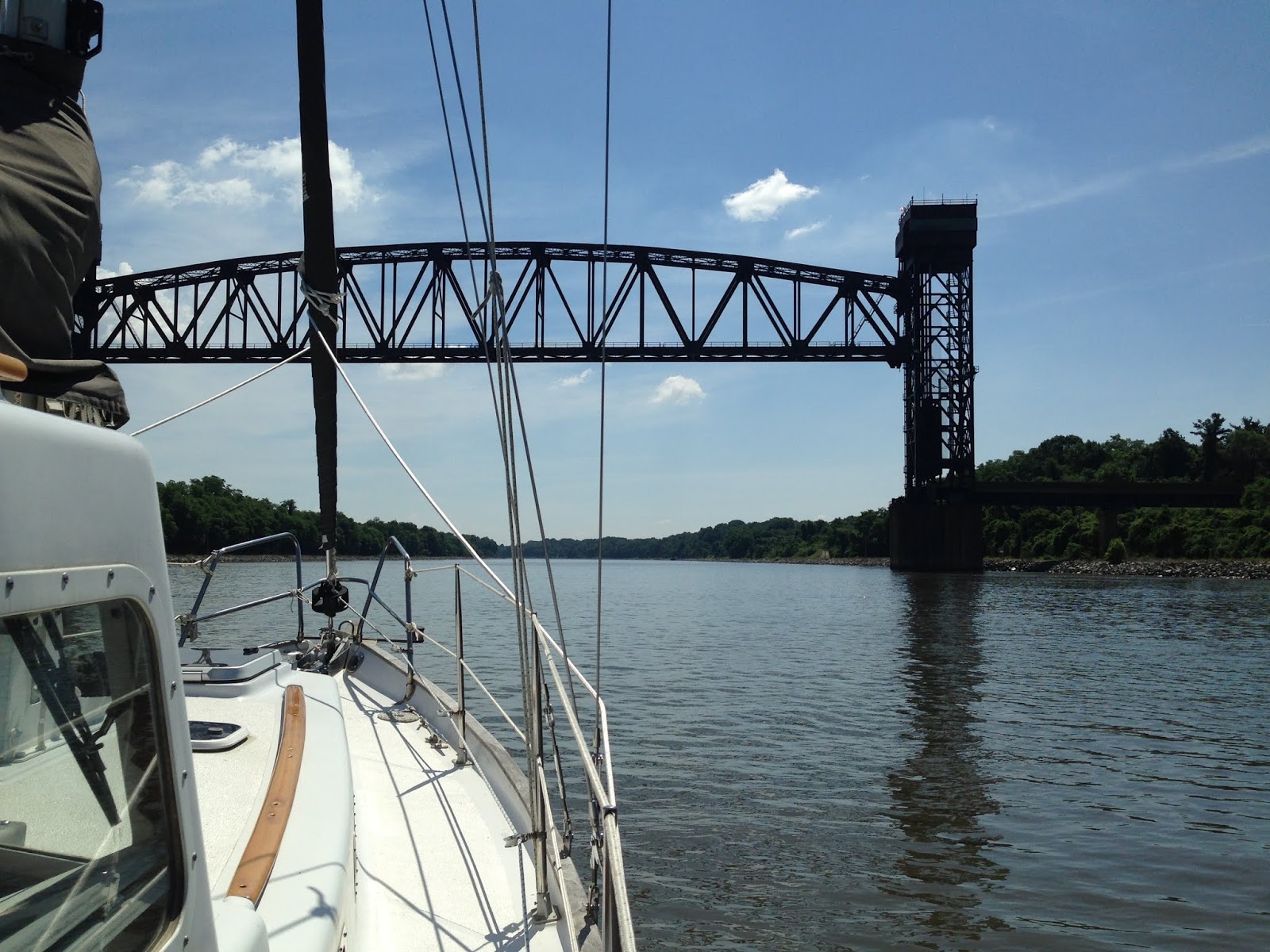
Conrail Lift Bridge, C&D Canal
We anchored just outside of the Canal in 23 ft (7 m) of water at almost slack water. It was very hot, in the 90s (32+C), so we had cold showers on deck to cool off. By three in the afternoon, the water was flowing by Rosalind at almost 3 knots (6 km/h). There was a light breeze on the water and it, together with the current, created an illusion that we were moving fast. It was a strange experience. We were treated to another beautiful sunset with no wind and slack water. We consulted Eldridge, planned our trip down Delaware Bay, and turned in early. We were going to have an early start (again!) to leverage the outgoing tide.

Sunset, Anchored off Delaware City, Delaware Bay


